
Scotland’s larger charities spend 7.6% of expenditure on fundraising
August 5, 2026
Project explores disintermediation – and reintermediation – of charities in new depth
August 17, 2026
The UK public has become more amenable to public and door-to-door fundraising, and less so to online fundraising platforms in recent years, says new research.
The report from the Fundraising Regulator also shows that overall public trust in UK charities has fallen since 2023, but donors’ actual experience of supporting charities remains largely positive.
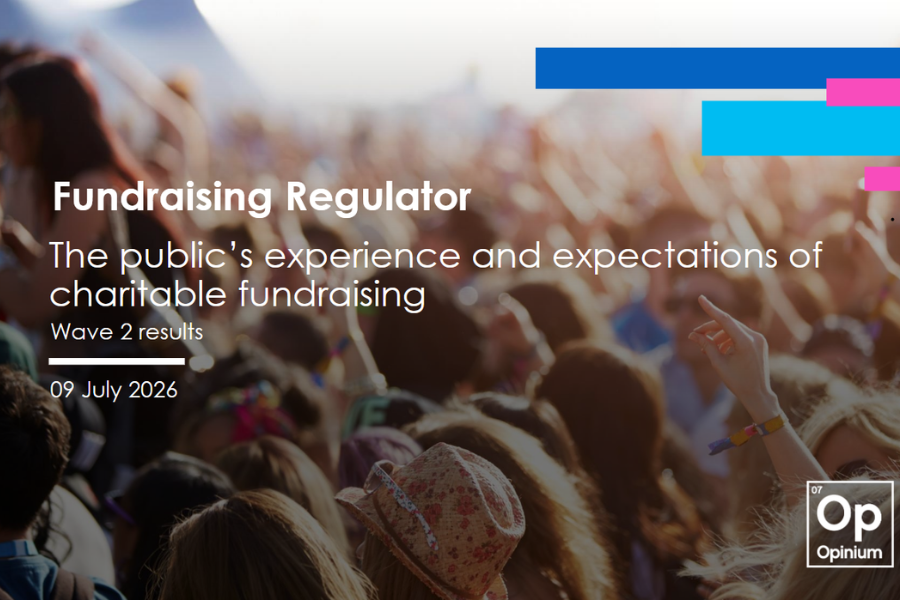 The organisation surveyed 3,018 adults across the UK — including Scotland, which has its own, separate regulator — in May 2026, and compared results with a previous December 2023 poll.
In 2023, 42% of respondents said they trusted local charities to deliver on their promises. This dropped to 34% in 2026, although they remain the second most trusted group (behind health professionals, at 46%).
For national charities, the figure dropped from 32% to 27%. For national government, it is now just 11%.
Fundraising experience: positive overall
However, trust in “people who ask you to donate money or goods to a charity” — which was the exact wording of the question — has remained stable. In both 2023 and 2026, just 16% said they did not trust fundraisers.
In addition, the experience of those who do donate to charities — around 85% of respondents in both 2023 and 2026 — remains largely positive.
In 2026, 23% called it ‘very positive’ and 41% called it ‘somewhat positive’, which are almost identical figures to 2023, although the report notes that the methodology means they are not completely comparable.
In both years, 29% answered ‘equally positive and negative’.
Method by method
The report also looks at peoples’ levels of comfort with different fundraising methods.
The most acceptable fundraising method was donation of goods — 81% of people said they were ‘very’ or ‘fairly’ comfortable, followed by sponsorship of individuals (68%), charity bags (65%) and charitable lotteries (64%).
At the other end, 28% were okay with door-to-door fundraising, 29% with telephone fundraising, 38% with text donations and 43% with tap to donate.
However, since 2023 comfort with online fundraising platforms has decreased from 60% to 52%, whereas it has increased for door-to-door fundraising (from 20% to 28%) and public fundraising (43% to 47%).
The report also shows significant differences between age groups — younger people are much more likely to be comfortable with both door-to-door and public fundraising. Donation of goods is the only category in which those aged 65+ are more comfortable than those aged 16-24.
Many make no checks
Asked what checks they made before making a donation, 32% said they did not make any. This rises to 53% of over-65s, but is lower than 20% for both 16–24s and 25–34s.
Meanwhile, 25% said they would look at the charity’s website, 21% would do some research on the cause area, and 18% would ask friends or family.
A less popular answer is looking for the Fundraising Regulator’s badge at 11%. However, 45% said in response to a separate question that they’d be more likely to donate to a charity displaying this badge.
Elsewhere, the research says that only 17% of respondents remembered seeing the regulator’s Fundraising Badge in the past year, while 47% said they had never heard of the Fundraising Regulator.
Paul Winyard, head of policy at the Fundraising Regulator, says that there are several positive findings for charities, and comments:
“Charities must continue to invest in strong oversight, effective training and responsible fundraising practices so the public can give with confidence and charities can continue to thrive.”