
Perceptions of public fundraising are improving in UK, says report
August 5, 2026
Join EFA to learn how fundraising can protect democracy & civic space
September 16, 2026
With other actors increasingly displacing charities in giving to good causes, asking for support, and providing help for people in need, a four-phase project has launched to help charities ‘reintermediate’ into the relationships and processes from which they are being displaced.
Phase one of the project from fundraising think tank Rogare and Kingston University Business School has just been completed with the launch of a white paper, Death by a thousand cuts: How other actors are displacing charities from giving, asking for support, and providing help.
The paper, out now, examines the threat of disintermediation to charities, and expands the typology of disintermediation (first published in the now Journal of Philanthropy in 2023) with more examples of how other actors, especially companies, are assuming ‘doing good’ roles.
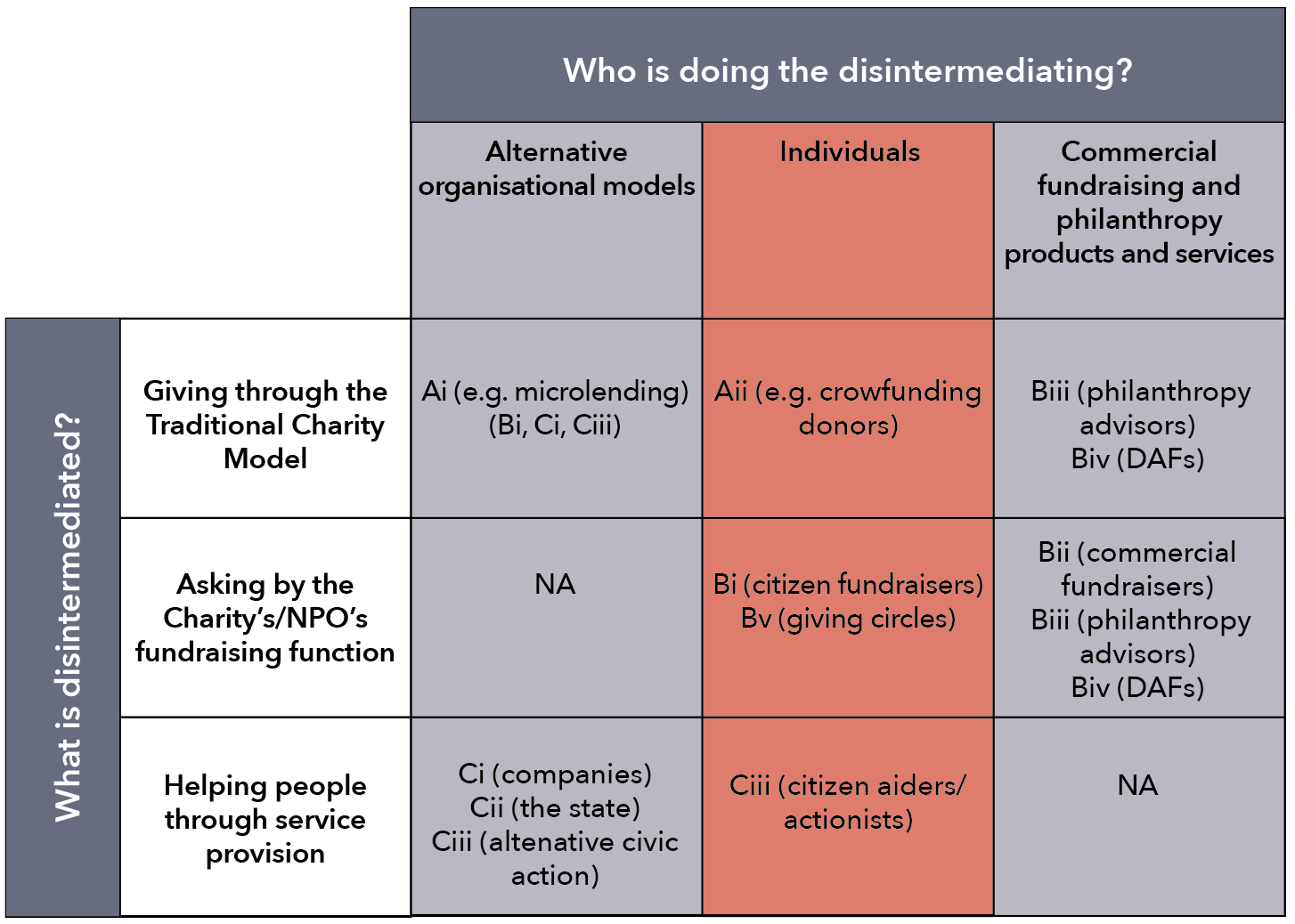
It also introduces two new ideas, exploring how who controls relationships with donors is a marker of whether disintermediation is occurring, and the concept of ‘citizen fundraisers’ – people who carry out fundraising on their own initiative outside the remit of reach of charity fundraising departments.
It considers too how philanthropy advisors, along with donor advised funds and giving cycles, can displace fundraisers from stewarding relationships with donors.
Commenting, Ceri Edwards, EFA president and executive director of engagement at the UK’s Chartered Institute of Fundraising, said:
“The concept of the ‘citizen fundraiser’ is helpful precisely because it describes something distinct from a traditional volunteer role. The evidence on peer-to-peer giving illustrates how much activity now takes place through individual fundraising pages rather than charities’ own channels. That creates opportunity, but it can also leave charities with limited visibility of, or influence over, the supporter experience.
“The answer is not to constrain people’s initiative. It is to build better routes into a charity’s mission: clear and proportionate onboarding, accessible tools and advice, appropriate safeguards, and stewardship that recognises citizen fundraisers as valued partners. If charities make engagement slow, difficult or controlling, people will go around them. But if they offer support and a compelling sense of shared purpose, they have a much stronger chance of building lasting relationships.”
Next steps
The three remaining phases of the project are as follows:
Phase 2 will explore the reasons why people might prefer to help directly, and identify the motivations and reasons that stakeholders cut charities out of philanthropic processes, with a paper expected to be published towards the end of the Northern hemisphere autumn/fall of 2026.
Phase 3 will examine the regulatory and ethical issues that emerge as disintermediation of giving, asking and service delivery becomes more widespread, with a discussion paper to be published before the end of 2026.
Phase 4 will enlist the input of the fundraising profession in identifying the ways that charities could reintermediate. Throughout 2027, this will include a series of webinars, seminars and roundtables – based on ideas from the first three phases – to gather the input of practitioners. The Chartered Institute of Fundraising in the UK will work with Rogare and Kingston University Business School on this phase and other partners will be sought in Europe.
The aim is to produce a toolkit for reintermediation towards the end of 2027 or early in 2028.
Ian MacQuillin, director of Rogare – The Fundraising Think Tank, said:
“We are all looking to grow giving and reverse what seems to be a decline in donations to charities. But what the move towards a ‘democratised’ disintermediation of charities tells us is that giving could be substantially grown, without any of that growth ever going near a charity bank account.
“Looking ahead a decade, if the majority of giving were disintermediated in a way that provided money directly to beneficiaries, would this be in the best interests of people who currently rely on the services provided by charities?
“While fully recognising that charities have no right to claim this space – that it has to be demonstrated and earned – and that in some, possibly many, cases, alternative ways of helping might indeed be the best ways, it might still be that charities are the most effective and efficient channels though which people who want to help can provide that help for those who need. If that is the case, then we need to find ways to reintermediate into the relationship and processes from which we are currently being cut out.”
Dr Rita Kottasz, associate professor at Kingston Business School, added:
“Should we accept a shrinking third sector when nonprofit mission and expertise still have so much to offer? Or is the right response to welcome more providers, precisely because the demand for help has never been greater? We need the map before we can begin to answer them.
“The beneficiaries we care most about are not donors but the people at the end of the pipeline – those who depend on well-coordinated, professionally-managed help. If charities are displaced by actors who cannot match charities’ expertise or safeguards, the risk to those people is real. If charities can understand where they have been cut out, and why, they can think far more clearly about what must change.
“This expanded typology is the necessary first step. You cannot plan a route until you have a map.”
The whitepaper Death by a thousand cuts: How other actors are displacing charities from giving, asking for support, and providing help can be downloaded from the project page of the Rogare site.