
Swiss foundations’ assets grow by 24% in five years
September 16, 2026
Book now for the 2026 EFA European Fundraising Forum
October 14, 2026
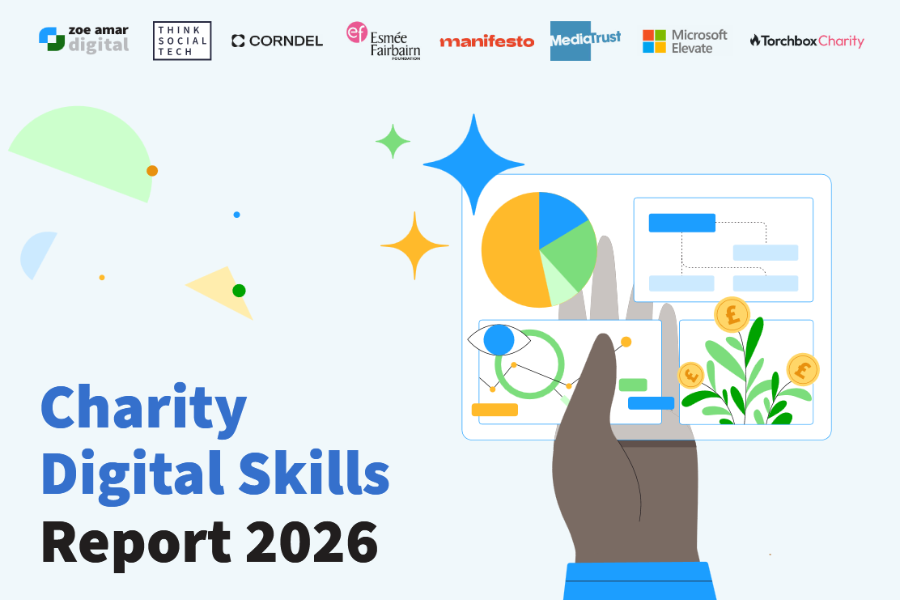
UK charities are prioritising digital reach above growing online fundraising income, while AI is an increasingly normal part of their grant applications, the Charity Digital Skills Report 2026 shows.
The report asked 807 organisations questions including their digital communications and fundraising priorities for the next 12 months.
Growing reach, presence and engagement was the top answer (59% of respondents), followed by increasing online fundraising income (51%); using data to better understand and engage with supporters (43%); revamping their website (36%) and developing content to improve visibility in AI search tools (29%).
 Larger charities placed a greater emphasis on improving supporter engagement (57%) and improving AI search visibility (45%), while smaller charities generally had a smaller group of priorities, with growing reach and presence still the most common goal overall (60%).
Young supporters: low priority
The report’s authors say that they were “surprised that, once again, growing a young supporter base was only a priority for a small proportion of charities – 25%, similar to 2025 data and identical for both large and small charities”.
This figure rises to 31% among charities identifying children and young people as a core target group, and to 45% of charities led by what it calls “global majority communities” (i.e. with leaders or founders from minoritised ethnic groups).
AI uses
The report also looks at how charities are using AI organisationally, with the top five applications being:
- Administration and project management: 63% (versus 48% in 2025’s report)
- Grant fundraising: 45% (2025: 36%), rising to 52% among smaller charities
- Social media: 39% (2025: 36%)
- Communications and fundraising: 36% (2025: 34%)
- Monitoring and evaluation: 31% (2025: 17%)
It flags that 58% of grantmaking organisations responding to the survey say that AI appears to be changing their applications – either increasing the volume of applications, or making them more repetitive.
However, 55% of grantmakers in the report said they weren’t sure how many of their applicants were using AI, and 19% said they thought none were.
Digital capacity lacking
The report expresses concerns about a lack of digital skill in charities’ leadership, saying that 46% of respondents (rising to 49% among smaller charities) do not have a trustee or board member with digital skills.
It also shows that only 22% of small charities and 37% of larger charities accessed funding towards digital costs in the last year. For 2026, 59% say that building skills of staff, volunteers and leaders is a priority, a significant jump from 43% in 2025.
Consultants and co-authors Zoe Amar and Nissa Ramsay write in the report foreword:
“Funders and support organisations must define their roles in supporting charities as AI and digital creates far-reaching changes across their work and society.
“Our data shows that charities are making digital and AI progress despite the huge financial and service demands they are facing. The fact that charities have achieved this growth, when the odds are against them, indicates that charities could increase their impact even further if funders step up to help charities at this critical stage in digital and AI development.”