
Sanna Kotiranta: “DEI Turncoats” – Defending diversity when it’s out of fashion
December 10, 2025
Czech Republic: nonprofits must beware the turning tide
January 14, 2026
The 16th annual EFA Skillshare and AGA took place in Edinburgh last month, hosted by the Chartered Institute of Fundraising, and taking the theme Fundraising for a Changing World: Power, Purpose and Possibility. Here are the key takeaways.
The event opened with the annual AGA and member workshop. The AGA saw EFA president Ceri Edwards – also executive director of change at the UK’s Chartered Institute of Fundraising (CIOF) – voted in for a second year, and Laurence Lepetit, CEO of France générosités, elected vice president. EFA welcomed two new members to the board: Charlotte Rydh, secretary general of Giva Sverige and previously EFA president, and Giedrė Šopaitė, founder, manager & NGO consultant, Baltic Fundraising Hub; and thanked Paul Laird and Francesca Lucci who stepped down.
-

- EFA board. L-R Charlotte Rydh, Giedrė Šopaitė, Ruth Williams, Ceri Edwards, Pia Tornikoski, Laurence Lepetit, Scott Kelley, Larissa Probst

-
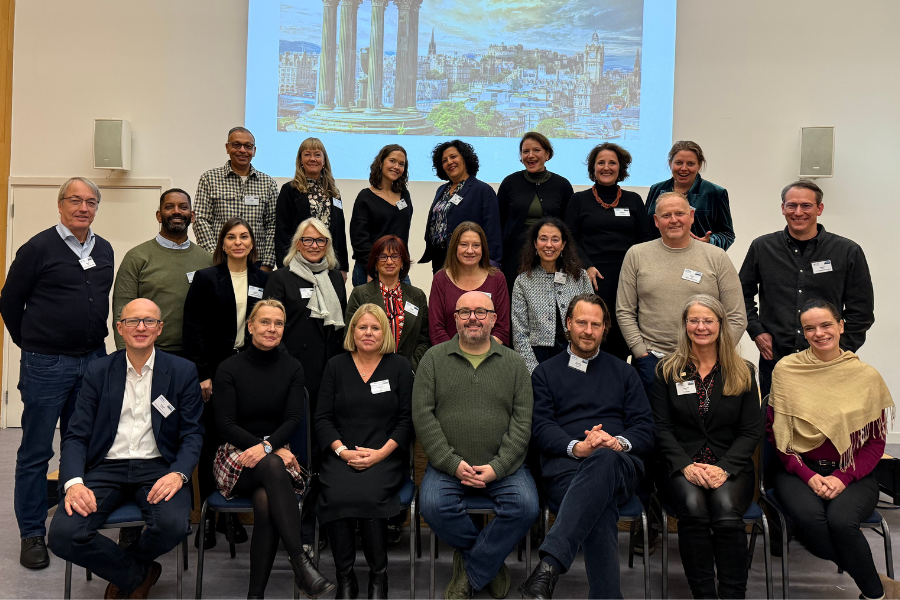
- Group shot of AGA and member workshop attendees
The state of civil society: a shrinking civic space
The Skillshare saw fundraising leaders come together across the day to share experiences, data and solutions around the theme: Fundraising for a Changing World: Power, Purpose and Possibility. Setting the scene in his welcome, EFA president Ceri Edwards noted the timeliness of the topic, with a striking 70% of members reporting challenges to civic space in a recent survey, including political attacks on CSOs, restrictive legislation, and curbs on civic freedoms. Funding is also becoming harder to find, and trust and engagement with fundraising is declining.
As a result, one big question is how both individual organisations and the sector can build resilience in this new age. Over the course of the day, some key themes emerged, including the need for new ways of thinking, and alternative models not just for fundraising, but for funding, mobilisation and collaboration. Fundraising, it’s clear, is no longer simply about raising money but defending democracy, and reclaiming power and purpose. Crucially too, support is needed from sector bodies, networks and partners to help nonprofits benefit from the opportunities that exist.
Looking at the future for civil society, Katerina Hadzi-Miceva Evans of the European Center for Not-for-Profit Law spoke about the acceleration of restrictions and attacks on civil society over the past year – in particular cuts in global aid that have impacted more than 50% of total budget and seen a fifth of organisations lose a devastating 70-100% of staff.
Examining how to respond, she said: “If the world is changing, we as organisations have to change. We need new models, strategies and networks. The external environment is challenging for all of us, but we’re less vulnerable if we come together.”
Global lessons: alternative funding models
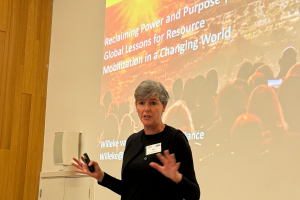
Willeke van Rijn, Resource Alliance
Willeke van Rijn of the Resource Alliance emphasised that nonprofits in the Global Majority have long navigated many of the pressures Europe now faces, meaning we can learn from them to help move forward. With ODA (Official Development Assistance) cuts and rising authoritarianism now hitting Europe, she urged organisations to explore alternative funding streams that build independence – such as impact and social investment, which are expanding in India and Africa.
“The only way to move forward is to collaborate,” she added. “New funding streams hold lots of potential. Can we get organisations together to explore, test, and help create financial resilience?”
AI: opportunities held back by skills gaps
Technology – from AI to digital channels – also provides ways to bolster resilience. AI offers opportunities, from improved communication, to deeper audience insight, said Dr Marta Herrero, from the Centre of Digital Innovation in Philanthropy and Fundraising, “Yet currently, we’re in a state of stasis, because we don’t have enough people with the capabilities to move forward.”
A recent survey by the centre showed knowledge and skills gaps as the top barriers for 75% and 67% of charities, including at leadership level. “It’s not just about understanding how to use AI, but how to implement it safely in a nonprofit environment,” Herrero added. “We need to step back to see what we must do to help the sector, including how to support leaders to understand how to lead on this.”
Digital mobilisation: rethinking social media
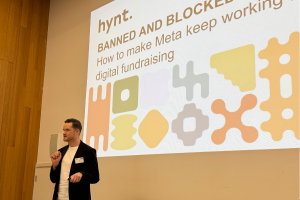
Joshua Leigh, Hynt
Facebook, attendees heard, remains the world’s most widely used digital platform, and despite Meta’s recent changes, offers major opportunities for nonprofits. Keeping it working means shifting from awareness-raising to a mobilisation-first model, said Joshua Leigh, Hynt, and using the platform to build first-party data lists and values-aligned communities. Authentic, timely storytelling is key – meeting people “where they are” on social media and giving them something meaningful to do.
“It’s about working out why you exist and attracting people who share your values, and then making it easy for them to take action and keep in touch,” he explained. “Ask people first if they care, and then to do something – this will bring you email addresses, and with email no one controls that message but you.” The more authentic the story and images, the better: UK housing and homelessness charity Shelter, for example, Leigh shared, has responded to hot temperatures with posts during heatwaves on why it exists that are relevant to this situation.
Building resilient fundraising: what high-growth organisations do differently
Fundraising as a whole can be bolstered to bring in more income that strengthens organisational resilience. Alan Clayton and Annemarie Devlin of Revolutionise shared the characteristics of organisations achieving strong fundraising growth.
Great fundraising organisations, they said:
- Define the problem they’re there to solve and use that to articulate their unique purpose
- Use their purpose as the reference point for decisions, setting targets based on long-term (10-year) goals
- Recognise donors’ fundamental need to solve problems – meeting that through the art of fundraising
- Operate as two interconnected businesses (donors and fundraising / services and service) with one mission
- Lead with both rational and emotional intelligence
- Have boards that value donors, fundraising, and long-term investment
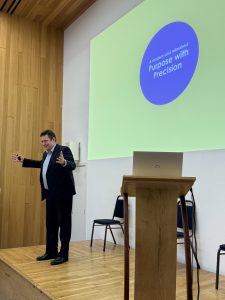
Alan Clayton, Revolutionise
“When leadership recognises that the only reason to give money is to solve a problem, fundraising accelerates, and when purpose is boss, you can get through the biggest block to fundraising, which is ego and fear,” said Clayton.
Emerging & underused income streams
Exploring and testing new ways of giving and fundraising is just as important for resilience building, and emerging and underused income streams were also discussed. Malcolm Fleming from the Association of Charity Lotteries in Europe (ACLEU) highlighted the €10bn annual potential for charity lotteries in Europe, with €1.5bn already being raised each year.
“Lotteries support a wide range of charities from small community groups to large nationals with mostly unrestricted, long-term funding – and the sum raised has been increasing year on year for the past 15 years,” he said. “People come for the prizes but stay for the charity.”
Emily Grint from Legacy Futures emphasised the scale and emotional power of in-memory giving – another sustainable and valuable source of income that can also be overlooked. In the past year, she said, 33% of UK adults, 30% of German adults and 14% of Dutch adults have donated in memory of a loved one, adding: “If you think in-memory giving is just a tiny proportion of the income you’re receiving, it’s probably hidden in your data because it can take so many different forms – from buying a pin badge to taking part in or running an event.”
In-memory supporters are also three times more likely to leave a legacy than standard regular givers, according to Legacy Futures research. The key to developing a relationship beyond that in-memory gift is understanding the supporter’s motivation and reflecting this meaningfully in communications.
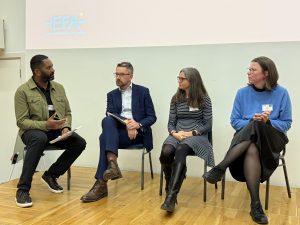
L-R: Paul Laird. Malcolm Fleming, Emily Grint, and Zuzana Suchová
Zuzana Suchová of Donio demonstrated how crowdfunding can channel anger into solidarity, support democracy and combat misinformation. Using humour, storytelling and the 30-30-30 rule to enlist influencers’ support in multiplying voices and donations, Donio campaigns have sparked extraordinary mobilisation – such as raising €500,000 in 48 hours for independent Slovak media.
“Humour provokes emotion, and anger mobilises action. Both inspire solidarity. We can use these platforms to make a difference,” said Suchová.
The power of data: philanthropy mapping in Europe
And let’s not forget data – another valuable tool for bolstering resilience. The European Research Network on Philanthropy (ERNOP) is soon to release Europe’s most comprehensive philanthropy mapping to date. Data on philanthropy is essential because organisations need to be evidence led, said ERNOP’s Barry Hoolwerf. It helps nonprofits stand up to scrutiny, to prove that strategies are effective, and secure buy-in. “Data on philanthropy is important for transparency and accountability, for voice, legitimacy and policy influence. Data is what any sector needs to be taken seriously, and to drive it forward,” he commented.
A sector moving forward together
And this is what 2025 Skillshare was about – supporting and moving the sector forward at a time of intense challenge and change. The day showed a wealth of opportunities – existing and emerging – from new financial models to technology, data and collaboration. It underscored too the crucial role for those supporting the sector: in raising awareness of the possibilities, and providing what nonprofits need in terms of information, training, networks and more to enable take up, and to strengthen that crucial resilience.
Thank you
An enormous thank you to this year’s speakers and participants, and to the Chartered Institute of Fundraising for hosting the event – including CEO Katie Docherty’s excellent walking tour of Edinburgh. Next year’s Skillshare and AGA will be held in Leuven, Belgium, on 19 – 20 November, kindly hosted by Fundraisers Belgium.

Delegates outside Edinburgh Castle